How-to
How to store heavy cookware without chips and scratches
Published
Short answer
Store cookware dry, with something soft between stacked pieces. Use felt or fabric pan protectors when nesting, store enameled Dutch ovens with the lid on upside down or slightly ajar, and never stack heavy pots on nonstick. Keep the heaviest pieces on a low, sturdy shelf or a strong drawer, and check the weight rating of shelves, hanging racks and wall anchors before loading them with cast iron.
Cookware for this job
All 7 picks compared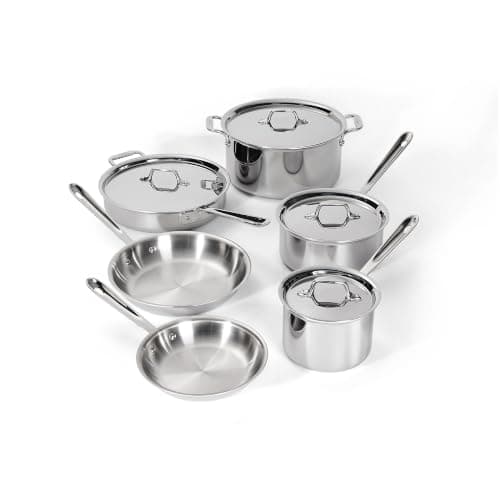
All-Clad D3 10-Piece: best clad stainless set
See price on AmazonSee it on Amazon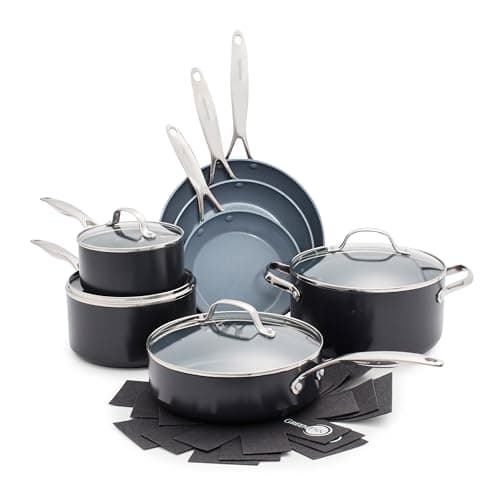
GreenPan Valencia Pro 11-Piece: best ceramic nonstick
See price on AmazonSee it on Amazon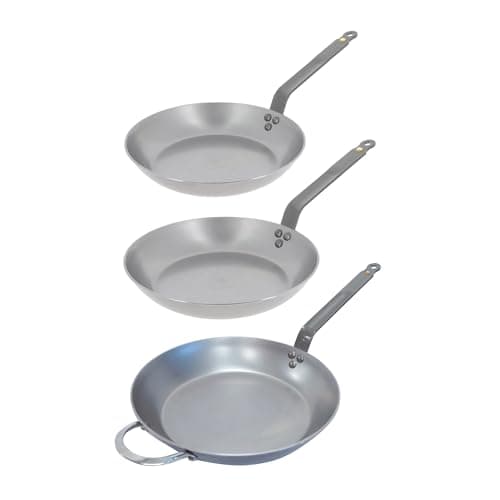
de Buyer Mineral B 3-Pan Set: best carbon steel
See price on AmazonSee it on Amazon
A cabinet full of nested pans is where a lot of chips, scratches and dents happen. Heavy enameled cast iron is especially at risk, and so is nonstick. This page is for home cooks who want to store pots and pans so they stay in good shape and are easy to reach. It covers pan protectors, stacking order, how to store Le Creuset and other Dutch ovens with their lids, hanging racks and lid organizers, and the shelf and drawer weight limits that matter with cast iron.
Before you put anything away
Every piece should be completely dry. Water trapped between stacked pans or under a lid causes rust on bare cast iron and carbon steel, rust on the exposed rim of enameled pots, and spotting on stainless. Dry with a towel, then let pieces air dry for a few minutes, or warm bare iron and carbon steel on a burner.
Give bare cast iron and carbon steel a very thin coat of oil before storing. Too much oil turns sticky and can go rancid during long storage. See how to season a carbon steel pan for how thin is thin enough.
Stacking pans safely
Pan protectors are inexpensive felt or fabric pads, often with flexible arms that drape over the rim. They stop the base of one pan from scratching the cooking surface of another. They are the simplest upgrade for anyone who nests pans.
- 1
Put the heaviest, toughest pans at the bottom: cast iron and stainless.
- 2
Lay a pan protector, a folded dish towel or a paper towel in each pan before nesting the next.
- 3
Nest pans of decreasing size so the bases sit flat inside each other.
- 4
Keep nonstick near the top of a stack or in a separate stack, with a protector under and over it.
- 5
Do not stack anything heavy on top of nonstick or enameled cast iron.
- 6
Keep stacks to a height you can lift off with one hand.
Note.Lifting heavy cast iron down from a high shelf is a common way to drop and chip it. Keep the heaviest pots at waist height or below.
How to store Le Creuset and other Dutch ovens
Enameled Dutch ovens chip most easily at the rim and the lid edge. Store each pot on its own rather than stacking pots inside each other. If you must stack, put a thick towel or protector between them and keep the heavier pot at the bottom.
Do not seal the lid tight during storage. A small amount of trapped moisture can cause rust spots on the exposed iron rim and odors inside. Common options are to set the lid on upside down, prop it open with a folded paper towel or a pot clip between lid and rim, or store the lid separately. Turning the lid upside down also protects the knob and keeps the pot easy to stack a light item on.
Wipe a thin film of oil on the exposed rim now and then to prevent rust. For more care details, see how to clean Le Creuset and chipped enamel on a Dutch oven.
Storing lids
- Vertical lid racks in a drawer or cabinet keep lids upright and visible.
- Door mounted lid holders use space on the inside of a cabinet door; check the door hinge can take the weight.
- Store glass lids where they cannot fall. A dropped tempered glass lid can shatter.
- Heavy cast iron lids are better stored on their pots, upside down, than on door racks.
- Pot racks with lid holders keep lids with their pans.
Shelf, drawer and rack weight limits
Cast iron and large Dutch ovens are heavy. A full set of enameled cast iron can exceed what a standard wire shelf, a thin particleboard shelf or a cheap pull-out drawer is built to carry. Shelves can sag over time, and drawer slides can fail. Check the rated load for shelves, drawer slides, pull-out organizers and hanging pot racks before loading them, and stay well under it.
Wall and ceiling pot racks must be fixed into studs or joists, or with anchors rated for the load. Drywall anchors alone are not enough for cast iron. Follow the rack maker's installation instructions and weight rating. If you are not sure the structure can carry it, ask a contractor.
Deep drawers with full extension slides rated for heavy loads are a good home for Dutch ovens, since you can lift the pot straight up without reaching over your head.
Nested in a cabinet with protectors
- Best for
- Stainless, carbon steel, most sets
- Watch out for
- Scratches without protectors; heavy stacks
Heavy-duty drawer
- Best for
- Dutch ovens, cast iron skillets
- Watch out for
- Drawer slide load rating
Hanging pot rack
- Best for
- Frequently used skillets and saucepans
- Watch out for
- Mounting into studs or joists; rack load rating
Wall rail with hooks
- Best for
- Carbon steel and light pans
- Watch out for
- Pans knocking together; wall anchors
Vertical pan organizer
- Best for
- Skillets and lids on their edges
- Watch out for
- Heavy cast iron can tip the organizer
Open shelf
- Best for
- Display Dutch ovens
- Watch out for
- Shelf load rating; dust and grease
| Option | Best for | Watch out for |
|---|---|---|
| Nested in a cabinet with protectors | Stainless, carbon steel, most sets | Scratches without protectors; heavy stacks |
| Heavy-duty drawer | Dutch ovens, cast iron skillets | Drawer slide load rating |
| Hanging pot rack | Frequently used skillets and saucepans | Mounting into studs or joists; rack load rating |
| Wall rail with hooks | Carbon steel and light pans | Pans knocking together; wall anchors |
| Vertical pan organizer | Skillets and lids on their edges | Heavy cast iron can tip the organizer |
| Open shelf | Display Dutch ovens | Shelf load rating; dust and grease |
Hanging pans
Hanging keeps pans from touching each other, so it removes most scratching. It works best for skillets, saucepans and carbon steel pans with a hole in the handle. Leave enough space between hooks that pans do not swing into each other. Over a stove, grease and steam settle on hanging pans, so many cooks hang them on a wall away from the cooktop.
Heavy enameled Dutch ovens do not hang well, since the loop handles are short and the weight is high. Keep those in a drawer or on a low shelf.
Material by material
Good storage pays off most with nonstick and enamel, which are the easiest to damage. For signs a piece is past saving, see when to replace nonstick pans. If you are buying new and space is tight, see the best cookware set and best Le Creuset cookware set guides, and check whether a set includes pieces you will actually use.
- Enameled cast iron: store separately, lid ajar or upside down, never under other pots.
- Bare cast iron: dry, thin coat of oil, protector if stacked.
- Carbon steel: dry, thin coat of oil, hang or stack with protectors.
- Clad stainless: stack with protectors or hang; very forgiving.
- Nonstick: always with protectors or hung, never under heavy pans.
- Copper: hang or store separately to protect the finish.
Frequently asked questions
How do you store Le Creuset? Dry, with the lid upside down or propped open, on a low sturdy shelf or drawer, and not stacked under other pots. Use a protector if anything sits inside.
Are pan protectors worth it? Yes for anyone who nests pans. They are inexpensive and prevent most scratches on nonstick, enamel and polished stainless.
Should I store pots with lids on? Not sealed. Leave the lid ajar or upside down so moisture can escape and odors do not build up.
Can a shelf hold cast iron? Only if its load rating allows it. Check the shelf and bracket ratings and keep the heaviest pieces low.
What you need for this
- See price on AmazonAmazon
All-Clad D3 10-Piece: bare tri-ply stainless
 See price on AmazonAmazon
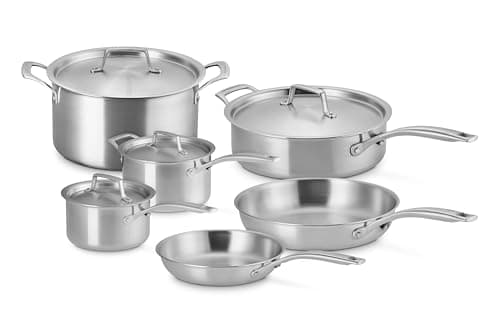
Le Creuset Essential Stainless 10-Piece: dishwasher, metal utensils
From Best Le Creuset cookware sets: enameled, stainless and nonstick
 See price on AmazonAmazon
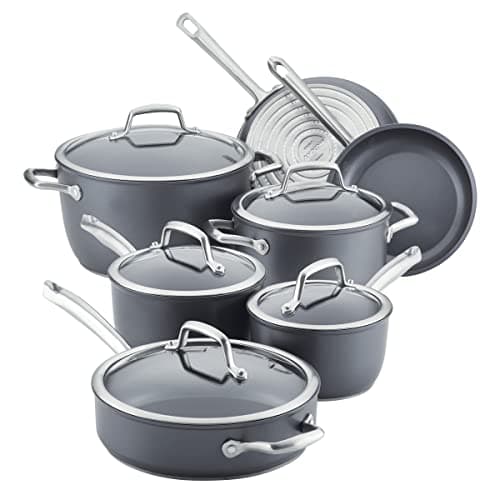
Anolon Accolade 12-Piece: forged, flush rivets
From Best nonstick cookware sets: hard anodized and clad picks
 See price on AmazonAmazon
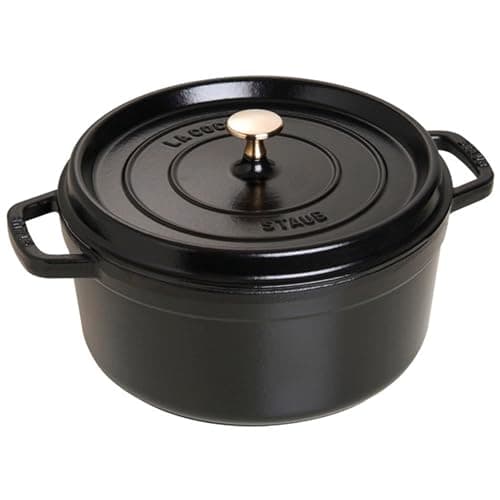
Staub 5.5 qt Round Cocotte: spiked lid, 900°F base limit
From Best Dutch ovens for home cooks: enameled and stainless picks