Explainer
What does clad mean in cookware: tri-ply, 5-ply and disc bottoms
Published
Short answer
Clad cookware is made from layers of metal bonded together into one sheet, then formed into a pan. Usually stainless steel is on the outside and the cooking surface, with a core of aluminum or copper in between to spread heat. Tri-ply has three layers and 5-ply has five. Fully clad pans carry the core all the way up the walls, while disc bottom pans only have it in a disc under the base.
Cookware for this job
All 7 picks compared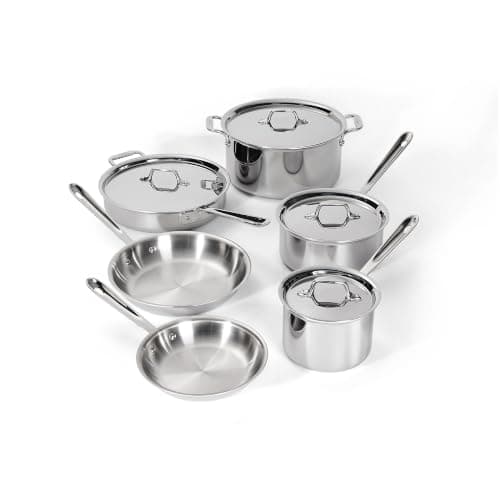
All-Clad D3 10-Piece: six pans incl. 8 qt stockpot
See price on AmazonSee it on Amazon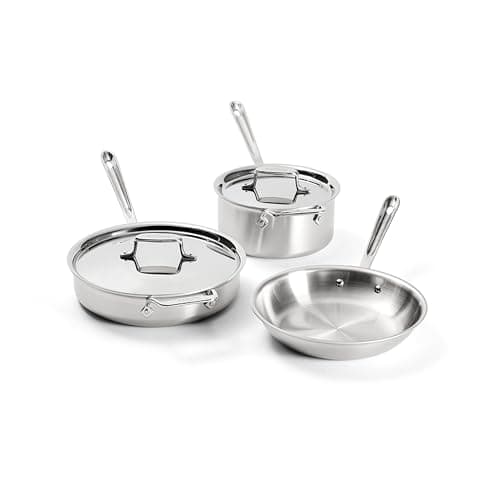
All-Clad D5 5-Piece: three core pans, 5-ply
See price on AmazonSee it on Amazon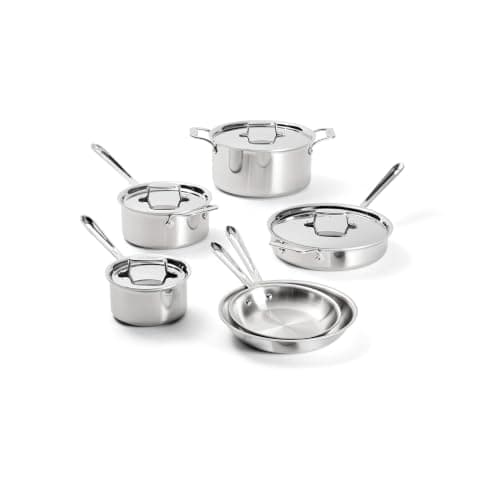
All-Clad D5 10-Piece: brushed 5-ply full kit
See price on AmazonSee it on Amazon
This page is for shoppers comparing stainless cookware who see terms like clad, tri-ply, 5-ply, copper core and impact-bonded base, and want to know what they mean in the kitchen. It explains why stainless alone is a poor heat conductor, how bonded layers fix that, how to read ply counts, and the real difference between fully clad and disc bottom pans. It also covers what All-Clad's main lines are made of, since that brand gave the category its best-known name.
Why stainless cookware needs a core
Stainless steel is durable, does not react with acidic food and is easy to clean, but it conducts heat poorly. A pan made only of stainless gets hot spots over the burner and cool zones elsewhere. Aluminum and copper conduct heat far better but are soft or reactive on their own.
Cladding combines them. Bonding a layer of aluminum or copper between sheets of stainless gives a pan with a stainless cooking surface and an inner layer that spreads heat across the base and up the sides. To clad something simply means to cover it with a layer of another material, and in cookware the layers are permanently bonded under heat and pressure. See cookware materials and heat conductivity for more.
Tri-ply, 5-ply and copper core
The ply count is the number of bonded layers. More layers do not automatically mean better heating; the total thickness and the metals used matter as much as the count.
Tri-ply
- Layers
- Stainless, aluminum, stainless
- How it behaves
- Responsive and even; the most common fully clad build
5-ply
- Layers
- Stainless with alternating aluminum and stainless inner layers
- How it behaves
- Often a bit heavier and steadier; slower to change temperature
Copper core
- Layers
- Stainless outside, aluminum and copper inner layers
- How it behaves
- Quick, even heat with a copper layer in the middle
Disc bottom
- Layers
- Clad disc fixed under a single-layer stainless body
- How it behaves
- Even base, but thin walls heat poorly
| Construction | Layers | How it behaves |
|---|---|---|
| Tri-ply | Stainless, aluminum, stainless | Responsive and even; the most common fully clad build |
| 5-ply | Stainless with alternating aluminum and stainless inner layers | Often a bit heavier and steadier; slower to change temperature |
| Copper core | Stainless outside, aluminum and copper inner layers | Quick, even heat with a copper layer in the middle |
| Disc bottom | Clad disc fixed under a single-layer stainless body | Even base, but thin walls heat poorly |
What All-Clad is made of
All-Clad sells several clad stainless lines. D3 is tri-ply: stainless, aluminum, stainless. D5 is 5-ply with alternating stainless and aluminum layers. Copper Core is a 5-ply build with a copper core bonded in, and the maker's listings describe the core as running rim to rim. All three are rated oven-safe to 600F on All-Clad's care page.
HA1 is a different product: hard-anodized aluminum with a PTFE nonstick coating, rated to 500F and not for the broiler. Compare the stainless lines in All-Clad D3 vs D5, or see the All-Clad cookware guide.
Fully clad vs disc bottom
In a fully clad pan, the bonded layers make up the whole body, so the heat-spreading core runs up the walls to the rim. Sauces heat evenly, food near the edge cooks like food in the middle, and the pan responds quickly when you turn the heat down.
In a disc bottom pan, also called impact-bonded or encapsulated base, a thick aluminum or copper disc is fixed under a single-layer stainless body. The base heats evenly, but the walls above the disc are thin stainless. That works fine for boiling water, stock and soups, and is common in large stock pots. For sauteing and reducing sauces, scorching tends to start where the disc ends.
A quick way to tell: a disc bottom pan has a visible step or ring where the thick base meets the thinner wall.
How to choose between them
Tri-ply covers most home cooking well. 5-ply and copper core add steadiness and cost. Compare brands in All-Clad vs Made In and All-Clad vs Tramontina.
- Frying and saute pans: fully clad tri-ply is the practical default. See the stainless steel frying pan guide.
- Saucepans: fully clad helps with reductions and custards that scorch at the edges.
- Stock pots: a disc bottom is fine for liquids and saves money and weight. See the stock pot guide.
- Induction: most clad stainless works on induction because the outer layer is magnetic stainless. Confirm in the listing, and see induction compatible cookware.
- Weight: 5-ply and copper core pans are usually heavier than tri-ply of the same size.
Oven limits for clad lines
All-metal clad pans handle oven heat well, but limits differ by maker. On the makers' own pages: All-Clad D3, D5 and Copper Core are rated to 600F, Made In stainless clad to 800F, and Caraway stainless to 550F. Glass lids are lower, often 350 to 450F. For other lines, check the maker's care page, or use the oven temperature checker.
Frequently asked questions
Is 5-ply better than tri-ply? Not always. 5-ply is often steadier and heavier, while tri-ply is quicker to respond. Both cook well when fully clad and thick enough.
What does clad mean in All-Clad? It refers to bonded layers of metal. All-Clad's stainless lines bond stainless steel around an aluminum or copper core.
Is a disc bottom pan bad? No. It is a good choice for stock pots and boiling. It is less even for sauteing because the walls above the disc are thin.
Does clad cookware work on induction? Most does, because the outer layer is magnetic stainless steel. Check the listing for your exact pan.
What you need for this
- See price on AmazonAmazon
All-Clad D3 10-Piece: bare tri-ply stainless
From Best All-Clad cookware: D3, D5, Copper Core and HA1 picks
 See price on AmazonAmazon
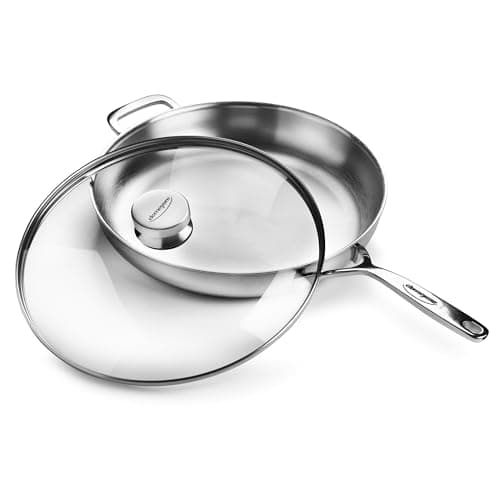
Demeyere 5-Plus 12.5 in with Glass Lid: 3 mm 5-ply
 See price on AmazonAmazon
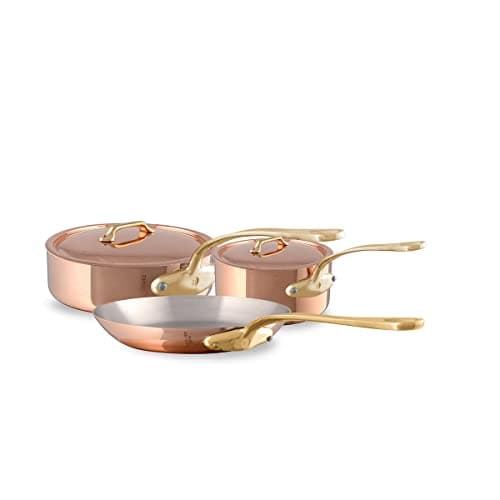
Mauviel M'Heritage 200 B 5-Piece: 2mm copper, brass handles
From Best copper cookware for home cooks: sets and single pieces