Fix
Warped pan: why it happens and whether it can be fixed
Published
Short answer
Pans warp when the metal heats or cools unevenly, most often from plunging a hot pan into cold water, heating an empty pan on high, or using a burner much smaller than the base. Thin pans and disc bottoms warp most. A slightly warped pan can sometimes be pressed flat, but results are unreliable; on induction and glass tops a pan that rocks usually needs replacing.
Cookware for this job
All 7 picks compared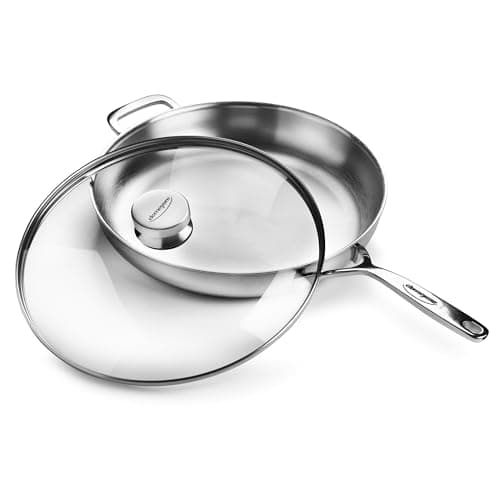
Demeyere 5-Plus 12.5 in with Glass Lid: 3 mm 5-ply
See price on AmazonSee it on Amazon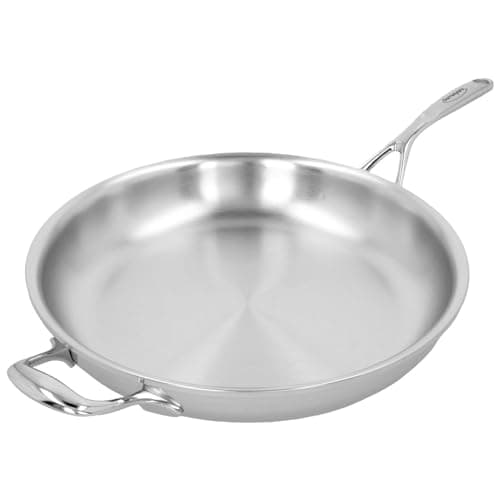
Demeyere Atlantis Proline 12.6 in: 7-ply, helper handle
See price on AmazonSee it on Amazon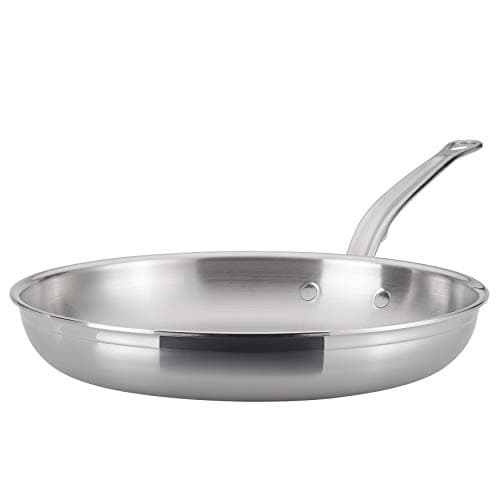
Hestan ProBond Forged 12.5 in: dishwasher safe
See price on AmazonSee it on Amazon
A pan that spins on the burner, rocks when you press the handle, or pools oil to one side has a warped base. This page is for cooks who want to know why it happened, whether it matters on their cooktop, and if there is any way to flatten it. We cover the main causes, how to check for warping, how much it matters on gas, electric coil, glass and induction, the home flattening methods people try and their risks, and how to choose and use pans so the next one stays flat.
Why pans warp
Metal expands when it heats and contracts when it cools. If one part of a pan heats or cools much faster than another, the stress pulls the base out of shape. Thin metal cannot resist that stress, so it bends. Once it has bent beyond a certain point, it stays bent when it cools.
This is called thermal shock, and the most common triggers are easy to avoid once you know them.
- Running cold water into a hot pan, or putting it in the sink while hot
- Heating an empty pan on high for a long time
- Using a burner much smaller than the base, so the center gets far hotter than the edge
- Thin, lightweight pans, especially single-ply aluminum or thin carbon steel
- Disc-bottom pans where a thick disc is bonded to a thinner pan body
- Induction boost settings on a pan with a thin base
How to check if a pan is warped
A slight bow that appears only when hot is common in thinner pans and does not always cause problems. A pan that rocks when cold is fully warped.
- 1
Set the pan on a flat countertop and press each side of the rim. If it rocks or spins, the base is not flat.
- 2
Lay a straightedge, such as a metal ruler, across the bottom of the pan. Look for gaps under the middle or at the edges.
- 3
Pour a thin layer of oil in the pan on a level surface. If it runs to the edge and leaves the center dry, the center is domed up; if it pools in the middle, the base is bowed down.
- 4
Check whether the warping changes when the pan heats. Some pans bow only when hot and flatten again as they cool.
How much a warped pan matters on your cooktop
Gas flames wrap around the base, so a warped pan still heats, though oil will collect on one side. Flat-top stoves heat by contact, so a gap under the pan sharply reduces heating. Induction needs the base close and flat against the glass; a warped pan may heat unevenly, rattle or not be detected. See cookware for glass-top stoves and induction-compatible cookware.
Gas
- Effect of warping
- Uneven heating and oil pooling
- Usually usable?
- Often yes
Electric coil
- Effect of warping
- Poor contact, hot and cold spots
- Usually usable?
- Sometimes
Glass or ceramic top
- Effect of warping
- Poor contact, slow and uneven heating, rocking
- Usually usable?
- Often not
Induction
- Effect of warping
- Poor contact, may not detect pan or may buzz
- Usually usable?
- Often not
| Cooktop | Effect of warping | Usually usable? |
|---|---|---|
| Gas | Uneven heating and oil pooling | Often yes |
| Electric coil | Poor contact, hot and cold spots | Sometimes |
| Glass or ceramic top | Poor contact, slow and uneven heating, rocking | Often not |
| Induction | Poor contact, may not detect pan or may buzz | Often not |
Can you flatten a warped pan
People try two home methods. The first is to heat the pan moderately, place it face down on a sturdy wooden surface, cover it with a thick towel or a block of wood and strike the high spot with a rubber mallet. The second is to press a cold pan flat with steady pressure from a mallet and wood block. Both can reduce a mild bow in a thin aluminum or carbon steel pan.
Results are unpredictable. Clad stainless pans resist flattening because the bonded layers fight each other, and hitting them can damage the cladding or handle rivets. Hammering a nonstick pan can crack the coating. Cast iron should never be struck; it is brittle and can crack. Enameled pans will chip. Treat flattening as a last attempt on a pan you would otherwise throw out.
Note.Wear eye protection, let any heated pan cool to a safe handling temperature, use oven mitts and keep fingers well clear of the mallet. Never hammer cast iron, enameled cookware or a pan on a glass cooktop.
When to replace a warped pan
Replace the pan if it rocks on a glass or induction cooktop, if a flattening attempt did not work, or if the warping has damaged a nonstick coating or loosened the handle. A rocking pan on a glass top is also a stability risk with hot oil.
For a replacement, choose a pan built to stay flat: fully clad stainless with a thick base, a thick carbon steel skillet, or cast iron. Our guides to the best stainless steel frying pans, best carbon steel pans and best cookware sets for induction list pans with heavier bases. See also what is clad cookware for why construction matters.
How to keep pans from warping
These habits also protect nonstick coatings and reduce heat tint on stainless steel; see stainless steel pan discoloration.
- Let pans cool on the stove before washing. Never pour cold water into a hot pan.
- Preheat on medium, not high, and never leave an empty pan on high heat. See how to preheat pans.
- Match the burner size to the base of the pan.
- On induction, avoid boost settings with thin pans and empty pans.
- Choose thicker, fully clad pans for high-heat cooking.
- Do not put hot pans in the dishwasher. See is cookware dishwasher safe.
Frequently asked questions
Can you fix a warped stainless steel pan? Sometimes a thin, single-ply stainless pan can be pressed back with a mallet and wood block. Clad stainless pans rarely flatten well, and trying can damage the layers. Replacement is often the practical answer.
Why do pans warp on induction? Induction heats the base directly and very quickly. On high or boost settings, a thin base can heat unevenly and distort. Use medium settings and pans with thick, flat bases.
Do cast iron pans warp? Rarely, because the iron is thick. Severe thermal shock can still warp or crack it, so avoid cold water on a hot cast iron pan.
Is a warped pan covered by warranty? Some makers cover warping under their warranty and many exclude damage from thermal shock or misuse. Check the maker's warranty terms for your line.